
Website AEO and GEO Checker is becoming an increasingly important concept for anyone trying to understand how modern AI-driven search systems like ChatGPT retrieve and present information.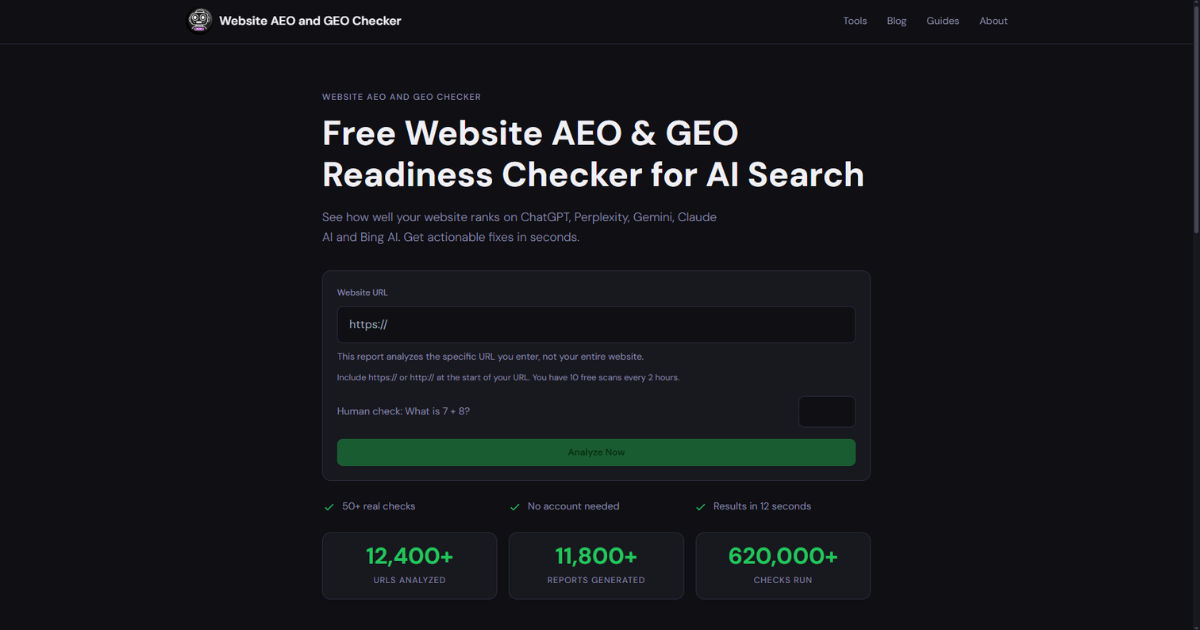
Unlike traditional search engines, ChatGPT does not simply “match keywords” — it uses advanced language understanding, semantic search techniques, and contextual reasoning to generate answers.
In this guide, we will break down how website GEO ChatGPT search works, how AI interprets web content, and what website owners can do to improve visibility in AI-based search systems. You will also understand how tools like a Website AEO and GEO Checker help identify gaps in website optimization for AI search.
What is Website GEO in ChatGPT Search?
GEO in Simple Terms
GEO stands for “Generative Engine Optimization.” It refers to optimizing content so that AI systems like ChatGPT, Gemini, or Claude can easily understand, extract, and reuse it in generated responses.
Traditional SEO focuses on ranking in Google. GEO focuses on being included in AI-generated answers.
When people talk about website GEO ChatGPT search, they are referring to how ChatGPT selects, interprets, and synthesizes website content during response generation.
Difference Between SEO and GEO
SEO (Search Engine Optimization)
- Focuses on ranking web pages
- Depends on keywords, backlinks, and metadata
- Designed for search engine result pages (SERPs)
GEO (Generative Engine Optimization)
- Focuses on AI comprehension
- Depends on clarity, structure, and meaning
- Designed for AI-generated answers
A modern Website AEO and GEO Checker helps bridge the gap between SEO and GEO by analyzing whether a website is AI-readable and context-rich.
How Website GEO ChatGPT Search Works
Step 1: Understanding the User Query
When a user asks ChatGPT a question, the system first tries to understand:
- The intent behind the question
- The context of the request
- The type of information needed
This is called intent analysis.
For example:
- “Best laptops for students” → product comparison intent
- “How does website GEO ChatGPT search work?” → educational intent
Step 2: Semantic Interpretation
Instead of matching exact keywords, ChatGPT breaks the query into meaning-based components.
For example, the query about website GEO is interpreted as:
- AI search systems
- Content retrieval methods
- Website optimization for AI
- Generative responses
This is where a Website AEO and GEO Checker becomes useful because it evaluates whether your content matches these semantic patterns.
Step 3: Knowledge Retrieval and Training Data
ChatGPT uses two main knowledge sources:
1. Pre-trained Knowledge
This includes information learned from:
- Books
- Articles
- Educational websites
- Public datasets
2. Real-time or External Tools (if enabled)
Some versions may also use:
- Web browsing tools
- Search APIs
- Indexed content retrieval systems
In both cases, the system does not “visit websites” like Google. Instead, it retrieves relevant patterns of information.
Step 4: Content Matching (GEO Layer)
This is where website GEO becomes important.
ChatGPT looks for:
- Clear explanations
- Structured paragraphs
- Context-rich sentences
- Topic authority
If a website is optimized using GEO principles, it has a higher chance of being understood and used correctly by AI systems.
A Website AEO and GEO Checker evaluates:
- Content clarity
- Topic depth
- AI readability
- Semantic structure
Step 5: Response Generation
After understanding and retrieving information, ChatGPT generates a response using:
- Natural language generation
- Context merging
- Logical structuring
It does not copy text directly but rewrites and synthesizes knowledge.
This is why GEO optimization is important — it ensures your content is “easy for AI to rewrite accurately.”
Key Factors That Influence Website GEO in ChatGPT Search
1. Content Clarity
Clear content is easier for AI to process.
Bad example:
“We provide solutions for digital optimization scalability systems.”
Good example:
“We help websites improve visibility in AI search systems like ChatGPT.”
A Website AEO and GEO Checker typically flags unclear or overly complex sentences.
2. Topic Depth
Shallow content is ignored by AI systems.
To improve GEO:
- Add detailed explanations
- Include examples
- Cover subtopics
3. Semantic Structure
AI prefers structured content:
- Headings
- Subheadings
- Logical flow
This helps ChatGPT understand relationships between ideas.
4. Authority and Consistency
Websites that consistently publish high-quality content are more likely to be referenced indirectly in AI training or retrieval systems.
5. Contextual Relevance
AI evaluates whether content actually answers the question.
For example, if a page talks about “SEO” but not “AI search,” it may not rank well in GEO systems.
How Website GEO Differs in ChatGPT vs Google
Google Search
- Shows ranked links
- User clicks results
- SEO determines ranking
ChatGPT Search (GEO-based)
- Generates direct answers
- No traditional ranking page
- Uses semantic understanding
This shift is why tools like Website AEO and GEO Checker are becoming essential for digital marketers.
What is Website AEO and GEO Checker?
A Website AEO and GEO Checker is a tool that analyzes how well a website performs in AI-driven search environments.
It evaluates:
- AI readability
- Semantic optimization
- Content structure
- Topic authority
- GEO readiness
It helps website owners understand whether their content can be:
- Understood by ChatGPT
- Used in AI-generated answers
- Ranked in generative engines
Why GEO Matters for ChatGPT Search
1. AI is replacing keyword search
Users increasingly ask questions directly to AI instead of search engines.
2. Content must be machine-readable
If AI cannot understand your content, it won’t use it.
3. Visibility depends on clarity
Unlike SEO, GEO is less about backlinks and more about meaning.
How to Optimize a Website for GEO in ChatGPT Search
1. Use Natural Language
Write like a human, not a machine.
2. Answer Questions Clearly
Use FAQ-style writing.
3. Improve Structure
Use:
- Headings
- Bullet points
- Short paragraphs
4. Focus on Topics, Not Just Keywords
AI understands topics better than repeated keywords.
5. Use Tools Like Website AEO and GEO Checker
These tools help identify:
- Weak sections
- Missing context
- Poor AI readability
Common Mistakes in GEO Optimization
1. Keyword Stuffing
Repeating phrases too often reduces readability.
2. Overly Complex Language
AI may misinterpret unclear sentences.
3. Lack of Structure
Walls of text reduce AI comprehension.
4. Ignoring User Intent
Content must match what users actually want to know.
Future of Website GEO in AI Search
The future of search is shifting from:
- “Searching pages” → “Getting answers”
ChatGPT-style systems will:
- Summarize websites
- Combine multiple sources
- Generate direct responses
This means GEO will become more important than traditional SEO.
A Website AEO and GEO Checker will likely evolve into a standard tool for all content creators.
Conclusion
Website GEO ChatGPT search represents a major shift in how online content is discovered and used. Instead of relying on traditional keyword ranking systems, AI models focus on meaning, structure, and context. This means websites must be designed not just for humans or search engines, but also for AI understanding.
Tools like a Website AEO and GEO Checker help bridge this gap by analyzing whether content is optimized for generative engines like ChatGPT. As AI continues to evolve, GEO will become a core part of digital visibility strategies.
Website owners who adapt early will have a strong advantage in this new AI-driven search ecosystem.