
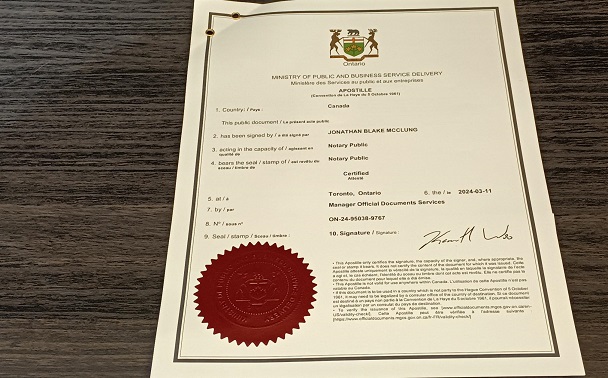
When dealing with official documents that need to be recognized in foreign countries, two common methods are used to authenticate them: Apostille certificates and embassy legalization. While both processes serve the same primary purpose—validating the authenticity of a document for use abroad—there are key differences in how these methods work, when they are used, and their requirements.
Apostille Certificates: A Streamlined Process for Hague Convention Countries
An apostille certificate is an internationally recognized form of authentication for documents that are to be used in countries that are signatories to the Hague Convention of 1961. This convention established a simplified process for authenticating documents across international borders, eliminating the need for complex and time-consuming embassy legalization in many cases.
The apostille is a certificate that verifies the authenticity of a document. It is issued by a designated authority, typically a government office or a notary public, in the country where the document originates. The apostille is affixed to the document itself and contains key information, such as the country of origin, the identity of the public official who signed the document, and details about the document’s nature. The purpose of the apostille is to confirm the validity of the document in another country that is part of the Hague Convention.
For example, if a U.S. citizen wishes to use a birth certificate in a country like France, which is a signatory to the Hague Convention, they can obtain an certificate to foreign government from the U.S. state government. Once the document is apostilled, it is automatically recognized in France without the need for additional steps.
Embassy Legalization: A Required Process for Non-Hague Countries
On the other hand, embassy legalization is necessary when the destination country is not a member of the Hague Convention. These countries require a more traditional form of document authentication, which involves a series of steps that culminate in the legalization of the document by the country’s embassy or consulate.
The embassy legalization process is often more complex and time-consuming than obtaining an apostille. Typically, it involves several steps:
-
Document Authentication: The first step is to verify the document’s authenticity with the appropriate government office, such as a secretary of state or foreign affairs ministry.
-
Consular Legalization: After authentication, the document is then submitted to the embassy or consulate of the destination country for final approval. The embassy ensures that the document meets its specific requirements and issues a stamp or seal confirming the document’s validity.
This process can vary widely depending on the country, making it essential to follow the precise instructions provided by the embassy or consulate to ensure the document is legalized correctly. The embassy's legalization is crucial because it ensures the foreign government will recognize the document as legally valid.
Key Differences Between Apostille and Embassy Legalization
The main difference between apostille certificates and embassy legalization lies in the countries involved. Apostille certificates streamline the authentication process for documents destined for use in Hague Convention countries, making the procedure simpler and faster. In contrast, embassy legalization is a more detailed and formal process that must be followed when dealing with countries outside the Hague Convention.
Another difference is the involvement of government agencies. With an apostille, a single government authority typically handles the process, such as a state-level office or notary. Embassy legalization, however, requires the involvement of both the local government and the embassy or consulate of the destination country.
In terms of time and cost, obtaining an apostille is usually faster and more affordable than embassy legalization, due to the streamlined process. Embassy legalization, due to its multiple steps and international coordination, can take longer and may involve higher fees.
Conclusion
Both apostille certificates and embassy legalization are crucial for ensuring that documents are recognized by foreign governments, but they are used in different circumstances depending on the country involved. Apostille certificates are the easier, quicker option for countries that are part of the Hague Convention, while embassy legalization is necessary for non-signatory countries. Understanding the differences between these two processes is essential for individuals and businesses engaging in international activities.